
Preventing and Addressing Family Violence: The Health Perspective

learn more
seeking participants
Family Violence Online Programming in Rural and Remote Areas of the Atlantic Provinces

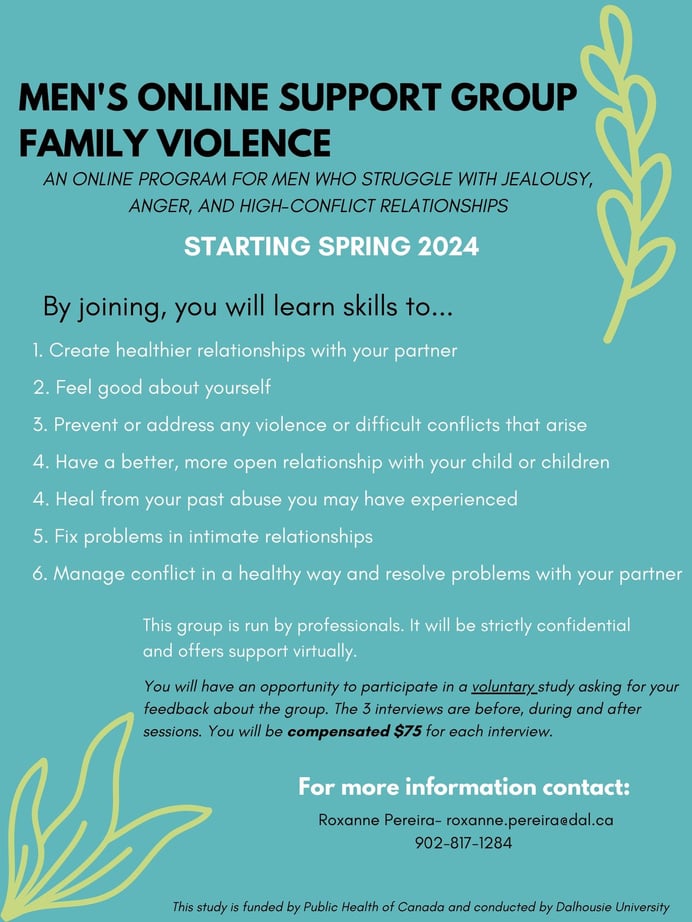
The purpose of this research is to improve access to effective programs that address family violence in rural areas by offering a group intervention called Safety and Repair online.

How will the study work?
The intervention will be conducted in rural and remote areas of four Atlantic provinces: Nova Scotia, Newfoundland, New Brunswick, and Prince Edward Island.
Each collaborating organization within these provinces will implement the intervention 3 separate times. The intervention will be offered virtually in different communities in each of the provinces. Given the focus on rural and/or remote areas, the intervention will be adapted in order to be offered in an online format to improve accessibility for individuals living in these areas.
The intervention is a 10 consecutive week online group with a maximum of 10 people attending per session.
Two service providers who are post-secondary level mental health professionals will facilitate each group.


Research Questions
1. To conduct situational assessment of community stakeholders to understand the programs and services to address family violence currently available in rural and remote communities and to determine potential needs and/or barriers to accessing the services for those experiencing or using family violence.
2. To determine if online family violence programming improves access and participation for rural and remote areas of the Atlantic Provinces.
3. To evaluate the effectiveness of the intervention by measuring changes in awareness and behaviours associated with family violence in service users; and to evaluate effectiveness of the intervention from the perspectives the group facilitators.



Study Population
Three populations will be involved in this research, community stakeholders (situational needs assessment participants), service users (group intervention participants) and service providers (intervention group facilitators).
Community stakeholders are individuals in the community who work with those experiencing family violence in the communities they serve such as child protection workers, shelter staff, legal, law enforcement, and other organizational staff .

Service users are those who will attend the group intervention. Service users include men, women and those who are gender diverse who have used violence and are seeking support to stop using violence.
Service providers are the individuals who will be facilitating the online group intervention.
Who can participate ?
To participate in this study you are an adult 18 years old or over.

Honoraria

Service Users will receive $75 for each interview (three interviews). In total they will receive $225.
Organizations
If you are interested in participating in a group please contact the organizations below. There will be a queer identifying group January 2024 hosted by Bridges. The women's group will be hosted by Autumn House.
Bridges- Kim MacDonald (she/her)Bridges@bridgesinstitute.org
Autumn House (Women's Group)- Jennifer Quinn Jennifer@autumnhouse.ca
Family Services of Eastern- Darlene Fewer (she/her) dfewer@fsens.ns.ca
John Howard Society- Melissa Noseworthy (she/her) mnoseworthy@jhsnl.ca
Nunatsiavut Government- Erin Broomfield (she/her) erin.broomfield@nunatsiavut.com
Family Violence Prevention Services- Tim Veinotte tim@fvps.ca

Who will be conducting the research
This research will be conducted by a team of social work and mental health researchers




Dr. Catrina Brown
Dr. Marjorie
Johnstone
Dr. Nancy Ross
Dr. Yoshiyuki Takano

Dr. Sulaimon Giwa

Dr. Scott Ronis

Dr. Ardath Whynacht

Amanda Dupupet

Contact us
Phone
902-817-1284
roxanne.pereira@DAL.CA
This study is funded by Public Health Agency of Canada and conducted by Dalhousie University